Car Totaled With a Loan: Insurance, Lien, and Title Steps
A practical sequence for coordinating a total-loss claim, auto-loan payoff, GAP coverage, and salvage-title paperwork when a lien remains.
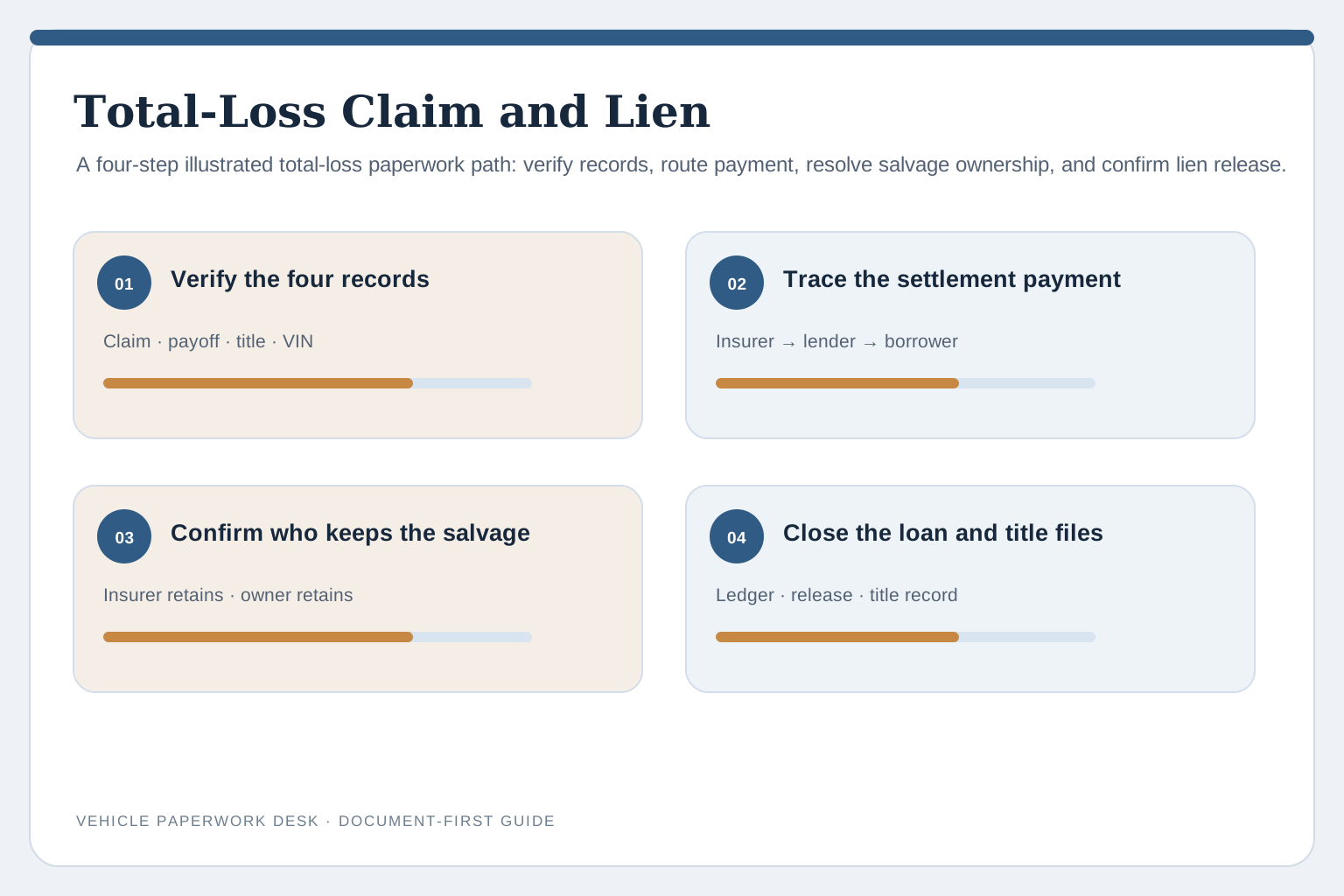
A car can be declared a total loss while the loan and title record are still open. That creates two connected but separate files: the insurance claim decides how the vehicle loss is valued and paid, while the lender and motor-vehicle agency handle the debt, lien, and ownership record. A check from the insurer does not by itself prove the loan is paid or the title is clear.
The order of events varies by policy, lender, salvage arrangement, and state. Start by identifying who currently holds the title, what payoff amount is valid through the expected payment date, and whether the insurer plans to take the vehicle or let you retain it. Keep the claim number, lender account number, vehicle identification number (VIN), and every dated document together.
First confirm the vehicle, claim, and title status
Ask the insurer for the written total-loss evaluation, the valuation date, the settlement amount, deductible, taxes or fees included, and any salvage deduction. Compare the VIN and owner names on the claim with the registration, title, and loan account. A small mismatch can delay a title assignment or payment even when everyone agrees the vehicle is a total loss.
Ask the lender for a dated payoff quote, not only the current account balance. Interest can accrue between the quote and the date the insurer sends funds. Confirm the lienholder's legal name, payoff address or electronic payment instructions, the account reference the payment must include, and what document the lender will issue after funds clear. If the lender has changed names or transferred servicing, get written confirmation of the successor that can release the lien.
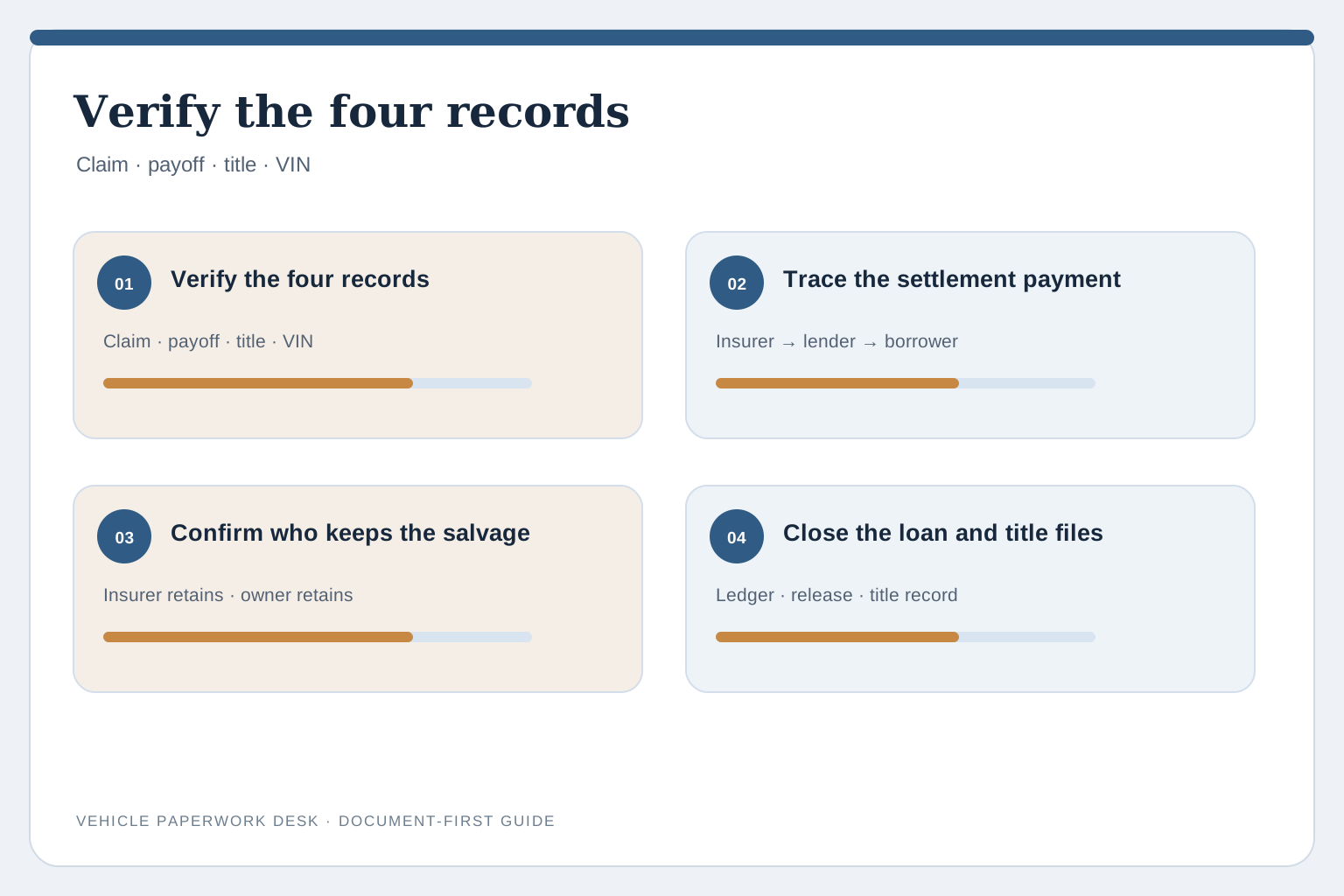
A checklist of the four records to compare before an insurer sends a total-loss settlement.
Understand how the settlement reaches the lender
If the title shows a lien, the insurer may issue payment jointly to you and the lender, send the lender its payoff directly, or use another process allowed by the policy and state title rules. Ask the adjuster to explain the payee names, amount, delivery method, and any document you must sign. Ask the lender how it will apply the funds and when it expects to report the loan paid. Do not endorse or redirect a joint-payee check until the lender explains what it requires.
The insurance settlement is generally based on covered value under the policy, not automatically on the unpaid loan balance. If the payoff is larger than the amount available from insurance, a remaining balance may still be due. The Consumer Financial Protection Bureau describes GAP as an optional product intended to cover some or all of the difference between a loan balance and an insurance payment after a vehicle is totaled or stolen. Coverage terms, exclusions, deductibles, and claim requirements depend on the actual GAP contract.
If the settlement is higher than the verified payoff and permitted charges, the remaining amount may be payable to you, subject to the policy, lienholder's interest, and state law. Request a written ledger showing gross settlement, deductible, payoff, fees or salvage deductions, and the net amount to each payee. If the arithmetic does not reconcile, ask which line item or date accounts for the difference before treating the claim as closed.
Check GAP or other add-on coverage separately
Find the GAP agreement, policy or waiver, retail installment contract, and claim instructions. Confirm whether it is insurance or a debt-cancellation product, who administers it, the covered loan balance definition, maximum benefit, waiting period, deductible treatment, and exclusions. A policy might exclude missed payments, late fees, prior negative equity, or certain vehicle uses; do not assume that a product called GAP pays every shortfall.
Submit the total-loss settlement statement, payoff history, insurance payment evidence, and any requested police or valuation records to the named administrator. Keep proof of delivery and ask for a claim number and written decision. Continue to review the loan account while the claim is pending. The lender may apply insurance proceeds first and calculate a remaining balance afterward; if the account still shows money due, request an itemized calculation and dispute a specific error in writing.
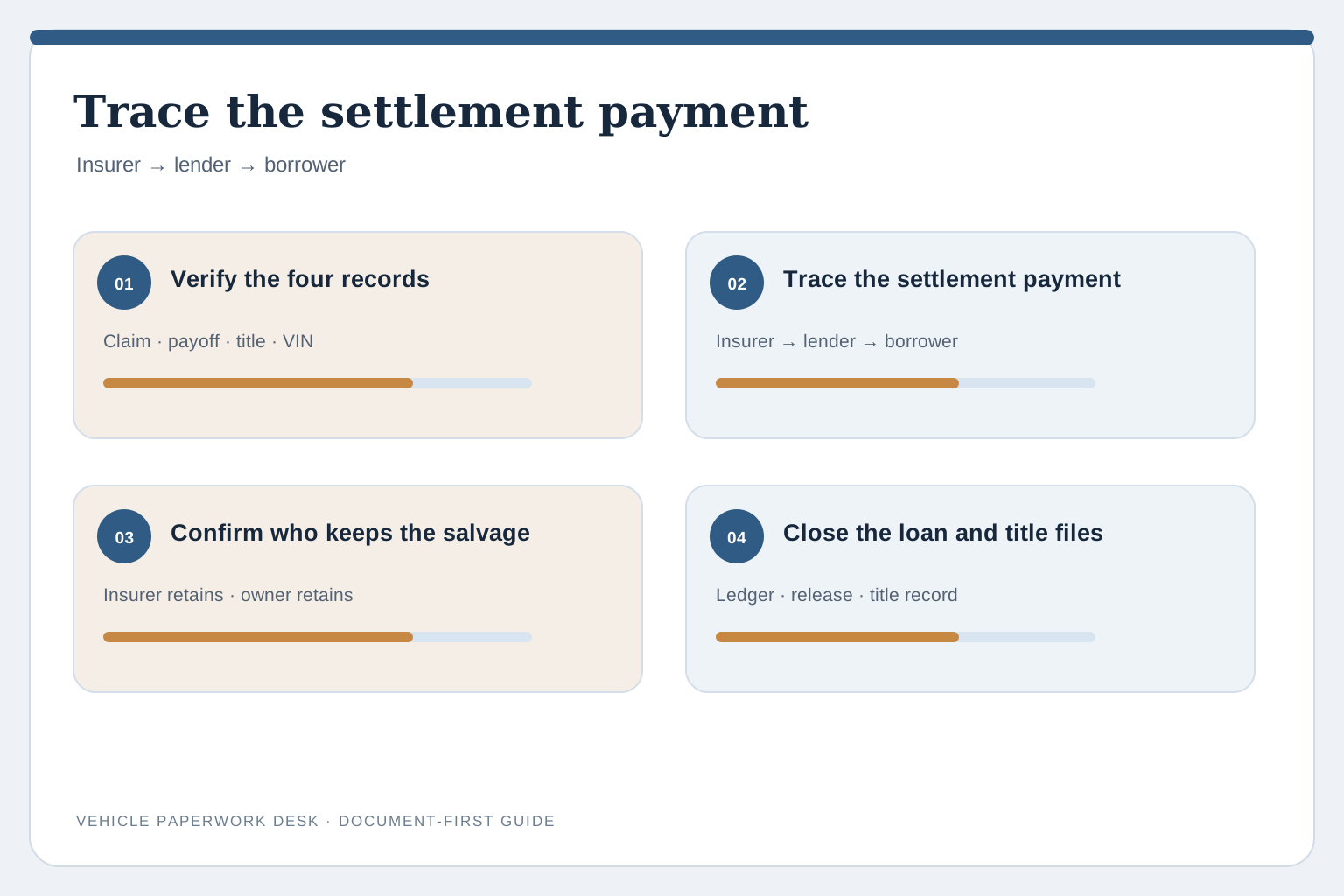
A flow showing insurer payment, lender payoff application, and how a remaining balance or net amount is checked.
Decide who keeps the damaged vehicle
In a standard total-loss settlement, the insurer may take ownership of the salvage in exchange for the agreed payment. If you want to keep the damaged vehicle, the insurer may calculate a different payment after a salvage deduction, but your lender's consent may be necessary because its security interest remains. Ask both the insurer and lienholder before accepting an owner-retained settlement or signing a title assignment.
Retaining the car can also change the title and registration steps. States use different labels and procedures for salvage, nonrepairable, rebuilt, or branded vehicles. California DMV, for example, describes when a salvage certificate is issued and identifies separate ownership documents that may be required when the existing certificate of title is unavailable. This is a California example, not a nationwide form list. Ask the agency that issued the current title which application, inspection, plates, and brand rules apply to your vehicle and who is responsible for filing each item.
Keep loan payments and insurance dates aligned
Do not stop scheduled loan payments solely because the adjuster has called the vehicle a total loss. Confirm with the lender whether payment remains due until the payoff posts, whether automatic payments can be changed, and how an overpayment would be handled. A payment that becomes due before insurance funds clear may affect the account even while the claim is being processed. Get any payment arrangement or deferment in writing rather than relying on an assumption that the insurer's check pauses the contract.
Separately check what your policy requires for removing or replacing a vehicle and when coverage on the damaged car ends. Do not cancel required coverage until the lender confirms the secured debt is closed and the insurer confirms the claim's remaining steps. If replacement-car financing is involved, do not roll an estimated unpaid balance into a new loan until the lender provides a final figure and the GAP administrator has addressed any claim.
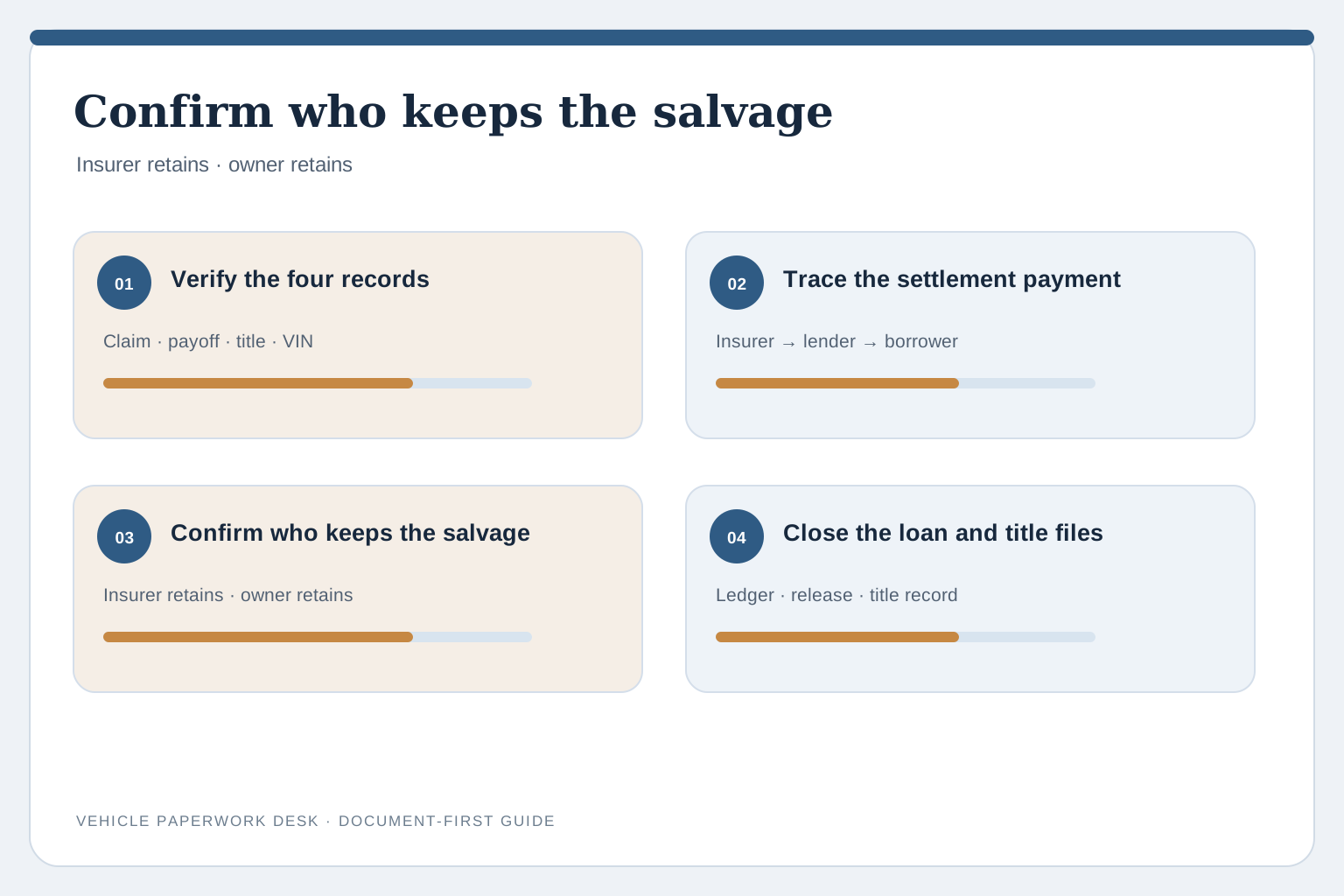
A comparison of the paperwork checkpoints when the insurer takes the vehicle or the owner retains it.
Dispute a valuation or payment without losing the paper trail
If you disagree with the vehicle value, read the policy's valuation and appraisal provisions. Ask the adjuster to identify comparable vehicles, mileage, condition adjustments, options, prior damage, taxes, and transfer fees considered. Send focused corrections with supporting records such as service history, option lists, dated photographs, and comparable listings. California's Department of Insurance explains that many standard policies contain an appraisal provision; whether it applies and how it works depends on the policy. Do not treat a sample process from another state as a deadline or guaranteed remedy.
If the payoff or title information is wrong, contact the party that controls that record. The insurer can correct its claim payee or settlement; the lender can confirm account application and release instructions; the motor-vehicle agency controls the state title record. Send a dated request that identifies the exact discrepancy, attaches the document showing it, and asks for one concrete correction or response date. Avoid sending the only original title or lien release without first checking the recipient's written requirements.
Close both files with verifiable documents
Before considering the matter complete, obtain the insurer's final settlement statement and proof of payment; a lender ledger showing how funds were credited and whether a balance remains; a paid-in-full or payoff confirmation if the debt is closed; and the lien release or electronic release confirmation. If the insurer keeps the vehicle, retain the signed title/ownership transfer and salvage receipt. If you keep it, retain the title application, salvage or rebuilt instructions, and proof of any required inspection or filing.
Then check the title record with the agency that issued it. A lender's message that it released its interest and an agency record showing the lien removed are related but distinct checkpoints. If either still conflicts with the file, use the title-record workflow in Lender Says the Lien Is Released but DMV Still Shows It. For questions about payoff-to-title timing, see How Long Should You Wait for a Title After Paying Off a Car?.
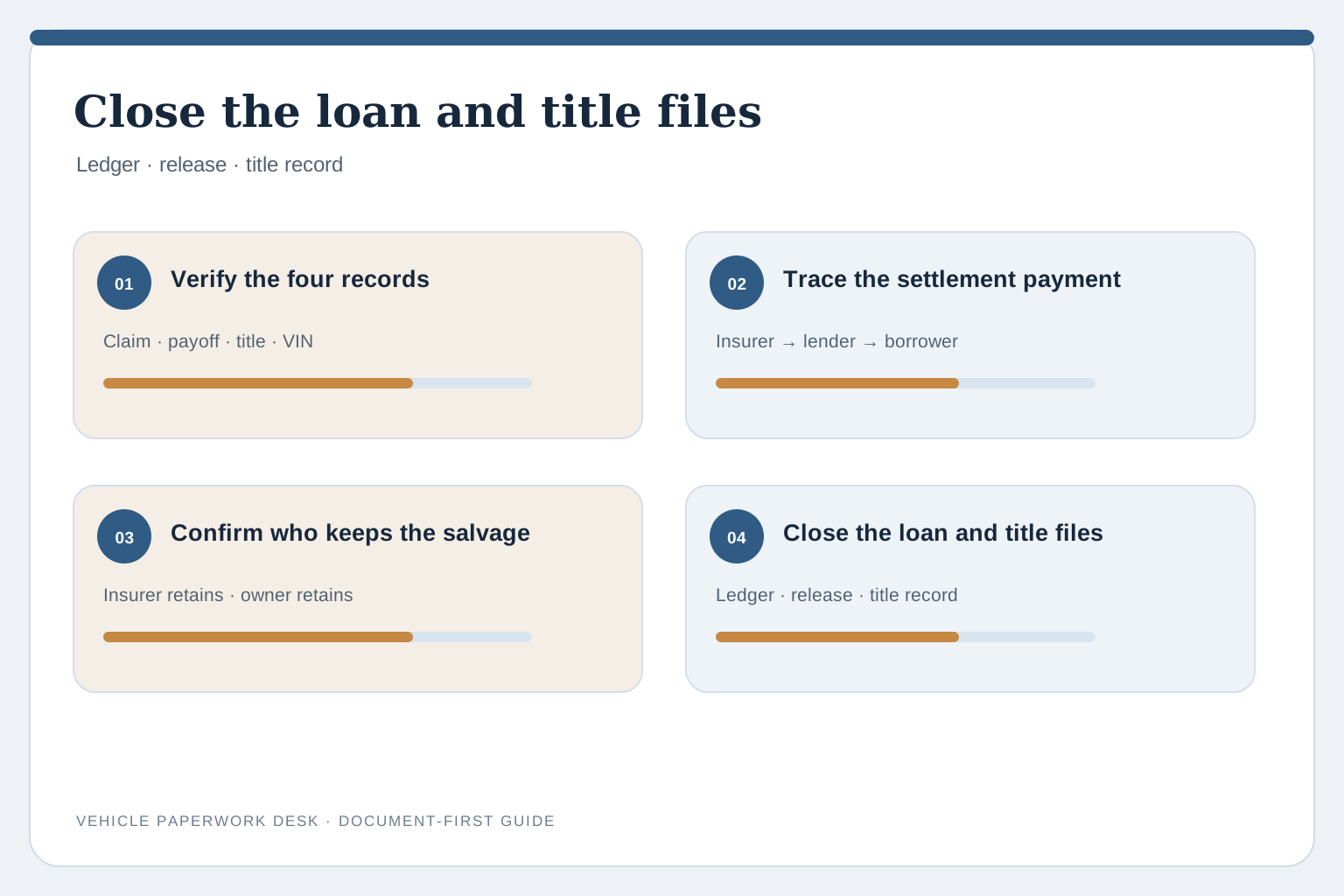
A closeout checklist for the insurer statement, lender ledger, lien release, and issuing-agency record.
A short settlement handoff example
Suppose the insurer values a car at $18,400, applies a $1,000 deductible, and the lender's payoff quote is $19,100 through the expected payment date. Those figures do not establish the final result by themselves: the policy may include other covered amounts, the payoff can change, and GAP eligibility depends on the contract. Ask the insurer how much it will send and to whom, ask the lender how it will post that amount, and ask the GAP administrator whether a claim may cover a remaining eligible shortfall. Save each written answer and compare the final lender ledger with the insurer's payment record.
Not legal or financial advice. Loan contracts, insurance policies, GAP products, title brands, salvage procedures, and lien-release rules vary. The California and Texas examples in the sources apply only to those states. Check your documents and the agency that controls your title record.
Not legal advice. This is general information; policy, contract, and state requirements vary. Verify current rules with the agency and provider handling your case.
General information only: This is general information, not legal advice - consult a local attorney for your specific situation. State law, contracts, and agency procedures can change the answer.
Sources
- CFPB - What is Guaranteed Asset Protection (GAP) insurance?
- Texas Department of Insurance - Auto insurance FAQ
- California Department of Insurance - So You've Had an Accident, What's Next?
- California DMV - Total Loss Salvage and Non-Repairable Vehicles
Sources are provided so you can verify the controlling public guidance. State forms, fees, addresses, and procedures can change.
Frequently asked questions
Does insurance pay off my car loan if the car is totaled?
The insurer applies the covered settlement under the policy and may pay a lienholder first, but the settlement may be less than the payoff. Ask for the payee breakdown and compare it with a current lender payoff quote. Any remaining loan balance depends on the contract, state law, and possible GAP coverage.
Do I still owe money if insurance pays less than the auto-loan balance?
A shortfall can remain. Ask the lender for an itemized post-payment balance and review any GAP insurance or debt-cancellation agreement. Coverage limits, exclusions, and claim steps are controlled by the actual product documents.
Can I keep a totaled car that still has a lien?
Possibly, depending on the insurer's settlement and state salvage rules, but first obtain the lienholder's written position. The lender's security interest may affect whether you can retain the vehicle or transfer its title.
Should I keep making car payments while a total-loss claim is pending?
Do not assume the claim pauses the loan. Ask the servicer whether payment remains due until funds post and get any payment change in writing. Confirm how an overpayment will be credited or refunded.
What paperwork proves the total-loss loan and title are closed?
Keep the insurer's final settlement and payment record, the lender's itemized account ledger and payoff confirmation, lien-release evidence, and the title transfer or salvage filing. Verify the lien status with the issuing motor-vehicle agency.