Repossession Sale Notice: What to Check Before the Car Is Sold
How to read a post-repossession sale notice, verify the sale method and dates, ask for a payoff or accounting, and preserve time-sensitive records.
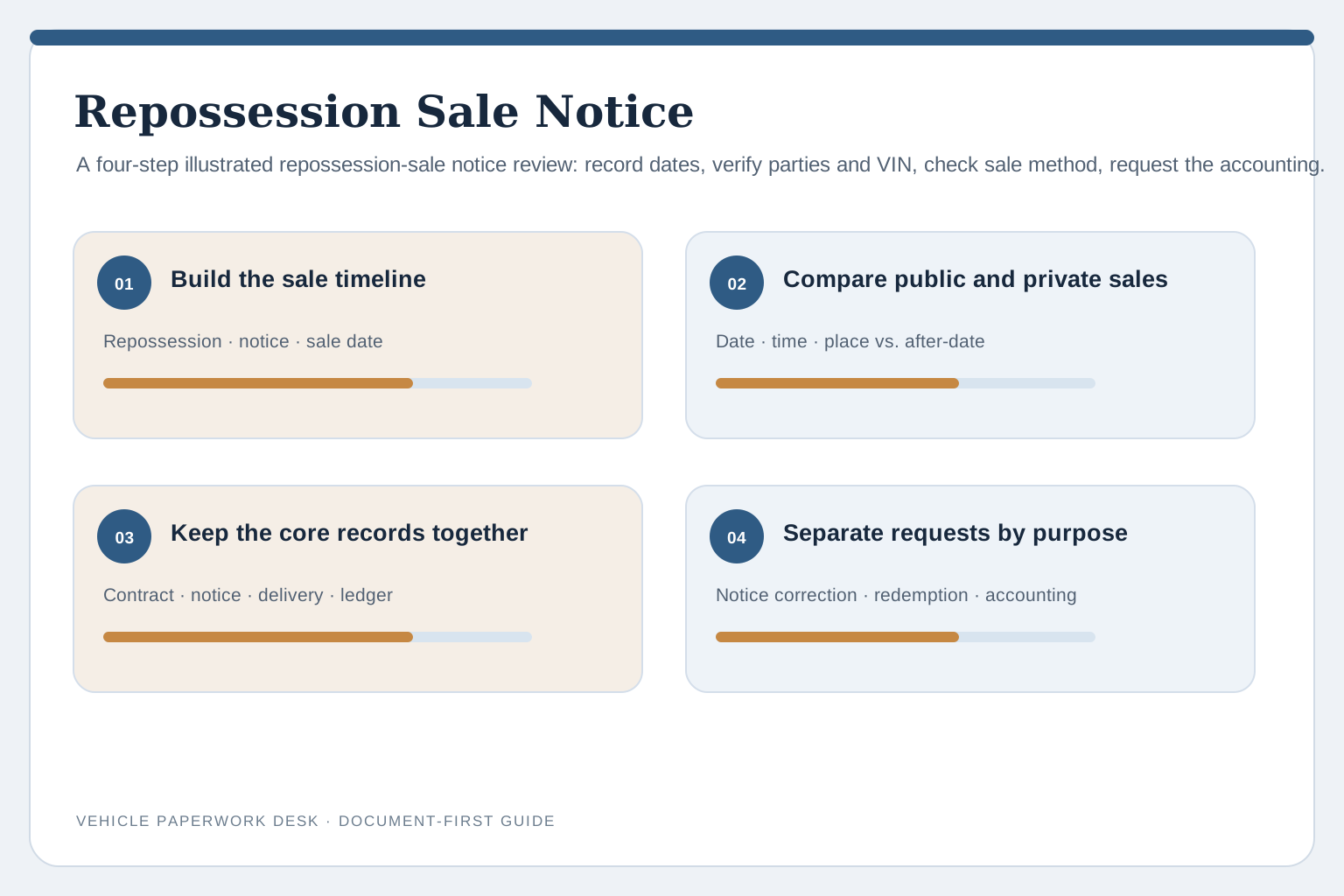
After a vehicle is repossessed, the lender may send a notice explaining how it plans to sell or otherwise dispose of the car. That notice matters because it can identify a public sale date and place, or state when a private sale may occur. It is not the same as a redemption quote, a final deficiency statement, or proof that the lender followed every rule. Read it promptly and keep the envelope, email headers, portal message, and attachments.
The rules are jurisdiction-specific. Article 9 of the Uniform Commercial Code has been adopted in state forms, but wording, timing, consumer notices, redemption rights, and other protections can vary. This guide gives a document-check workflow, not a conclusion about whether a particular notice or repossession is lawful.
Record the dates before calling
Write down the repossession date, the date printed on the notice, when and how you received it, any stated sale date, and every response deadline. Save the postmark or delivery tracking and take a screenshot of a portal notice before it changes. If the car was moved between a storage lot and sale facility, ask the lender to confirm its current location and the planned disposition method in writing.
Do not assume that a notice date is the date you received it or that a sale will be postponed because you asked a question. If the vehicle may be sold soon, call the lender's recovery or loss-mitigation unit and send the same request in writing. Ask for the name of the person or unit handling the file and a case number. A dispute, complaint, or request for documents may not pause the sale unless the lender confirms a hold or the law provides one.
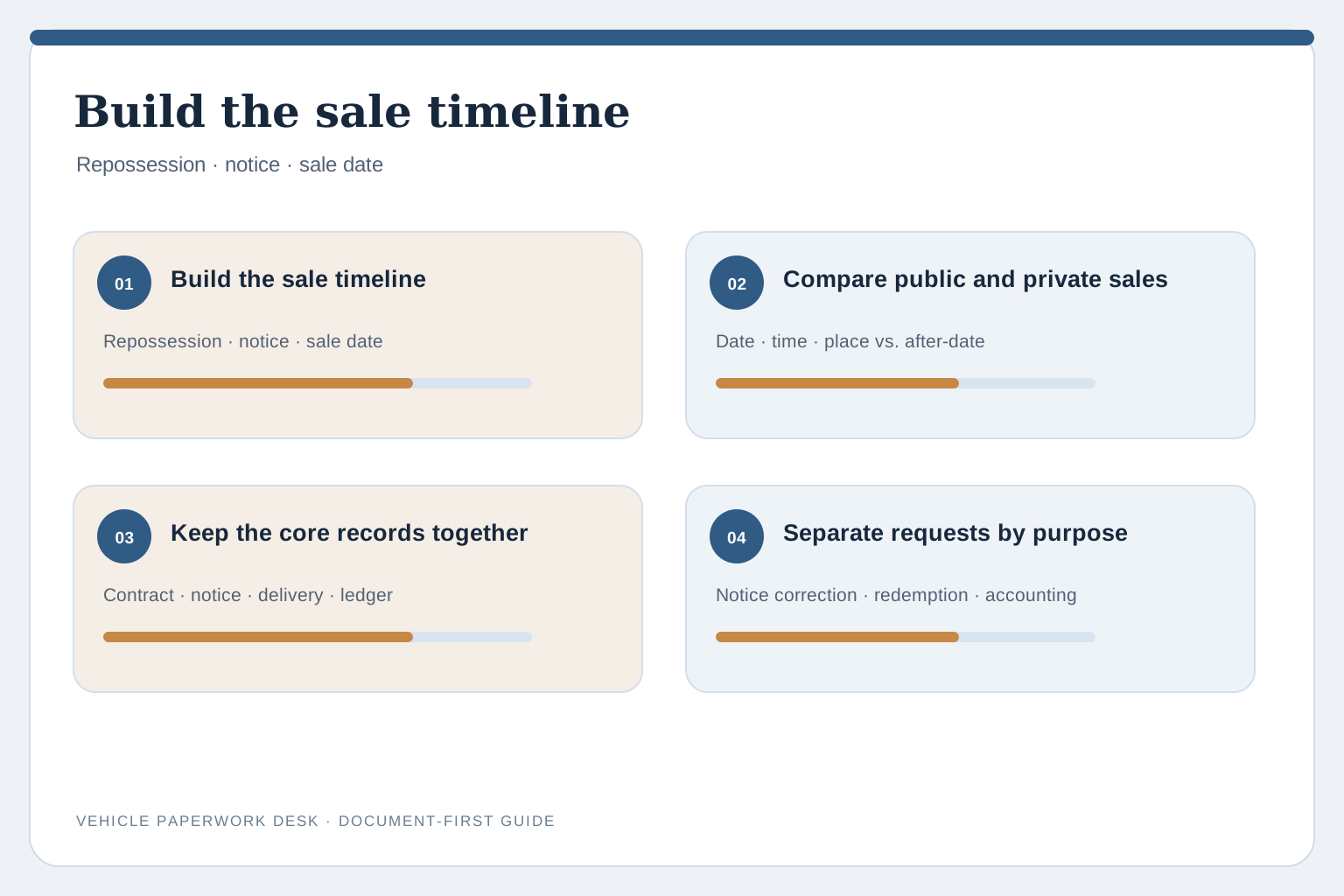
A timeline linking the repossession date, notice receipt, any response deadline, and planned disposition.
Identify the debtor, lender, and vehicle
Check every name and identifier against the contract and vehicle record: borrower, co-borrower or guarantor, secured party or current loan servicer, year/make/model, VIN, account number, and mailing address. A servicer may send the notice for an assignee, so a different company name is not by itself proof of a defect. Ask the sender to identify its role and the creditor that owns or enforces the security interest.
If the notice lists a wrong VIN, wrong borrower, old address, or account already paid, send a concise correction request with the document that shows the mismatch. Keep a copy. Do not alter the notice or rely only on a phone representative's assurance that someone will "fix it." If you are an obligor who was not addressed, ask whether the applicable law required a separate notice to you. The answer depends on state law and the transaction documents.
Check the method and sale information
A public disposition notice may identify the date, time, and place and explain whether the sale is an auction. A private disposition may state the date after which the lender expects to sell. The applicable statute may also require notice of the debtor's rights, the secured party's contact information, an unpaid-debt accounting, or other prescribed content. Consumer-goods transactions can have different form requirements from nonconsumer collateral. Compare the notice with your state's current version of the governing statute and any required form; do not rely on a generic internet template.
The Federal Trade Commission explains that state law may require the lender to tell you about a public auction's time and place or, for a private sale, the date after which it may sell. Texas Business and Commerce Code Chapter 9 provides a state example: it addresses notice content and timing, and Section 9.612's 10-day timing rule is expressly for transactions other than consumer transactions. Do not treat that 10-day rule as a universal deadline for a consumer auto loan.
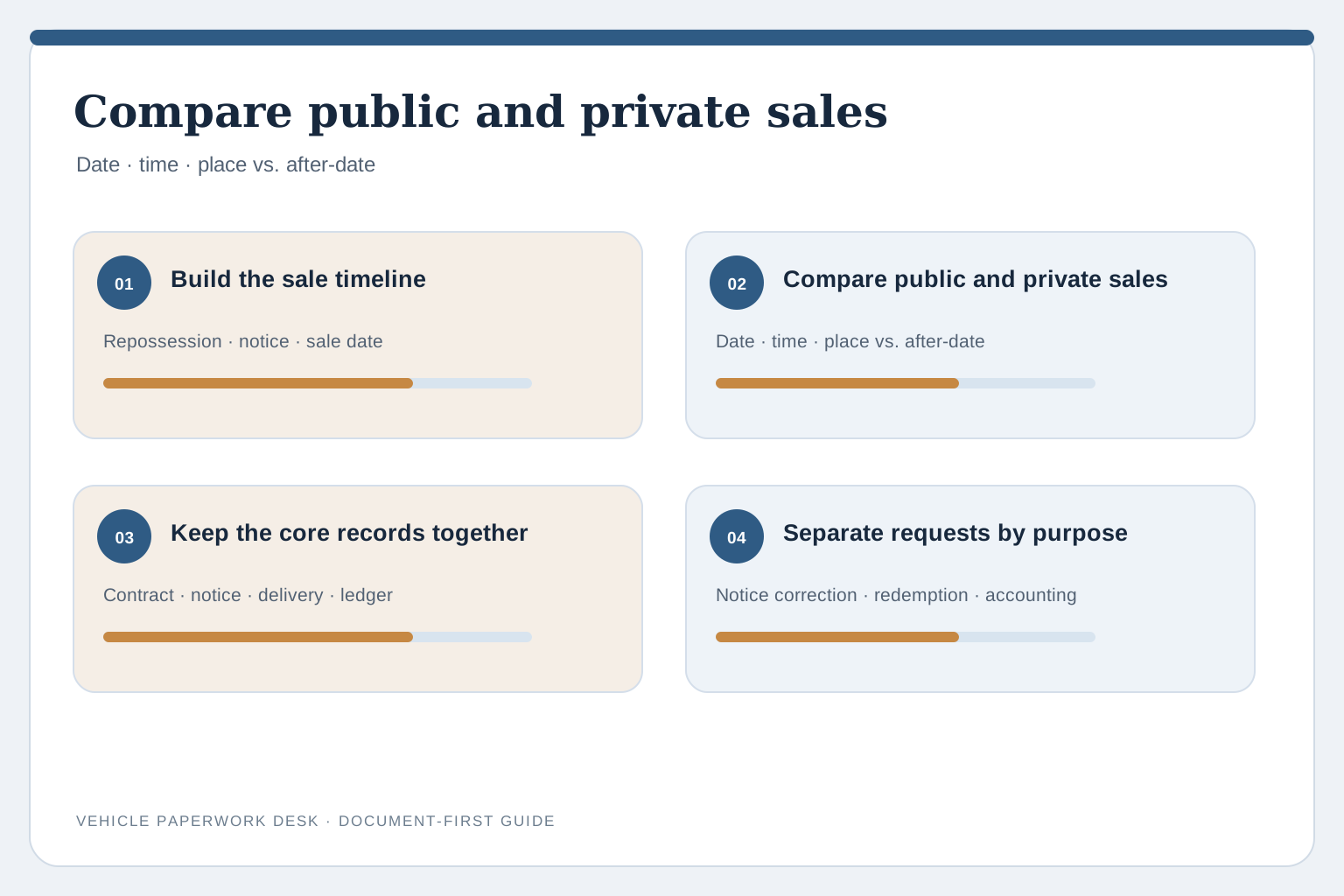
A comparison of the sale details a public auction notice and private-sale notice may identify.
Request the numbers separately from the notice
A sale notice often is not a current amount to redeem the vehicle. If you may try to recover it, ask the lender for a written, date-specific redemption amount, the accepted payment methods, the deadline, and where to deliver funds. The balance may include the secured obligation and permitted expenses; the exact amount and whether reinstatement is available depend on state law and the contract. The general Article 9 rule describes redemption before the secured party has disposed of the collateral or entered a binding contract for its disposition, but local law and the facts control. Get advice quickly if you intend to redeem.
You can also ask for an accounting of the unpaid indebtedness and an explanation of fees, storage, transport, and sale-preparation charges. Keep that request distinct from an objection to the sale notice. If a quoted amount changes, ask for a ledger showing the calculation date, payments, fees, credits, and per-diem interest. The article How to Get a Written Redemption Quote After Repossession covers the quote itself.
Preserve a focused evidence file
Save the signed retail installment contract, payment history, default and cure notices, repossession receipt, sale notice and delivery evidence, lender messages, insurance records, and any redemption quote. Keep photos or receipts relevant to vehicle condition and personal property, but do not mix unrelated account issues into the first request. Make a one-page chronology with the source for each date. This helps you spot whether the dispute is about notice, the account balance, the vehicle identity, access to belongings, or another issue.
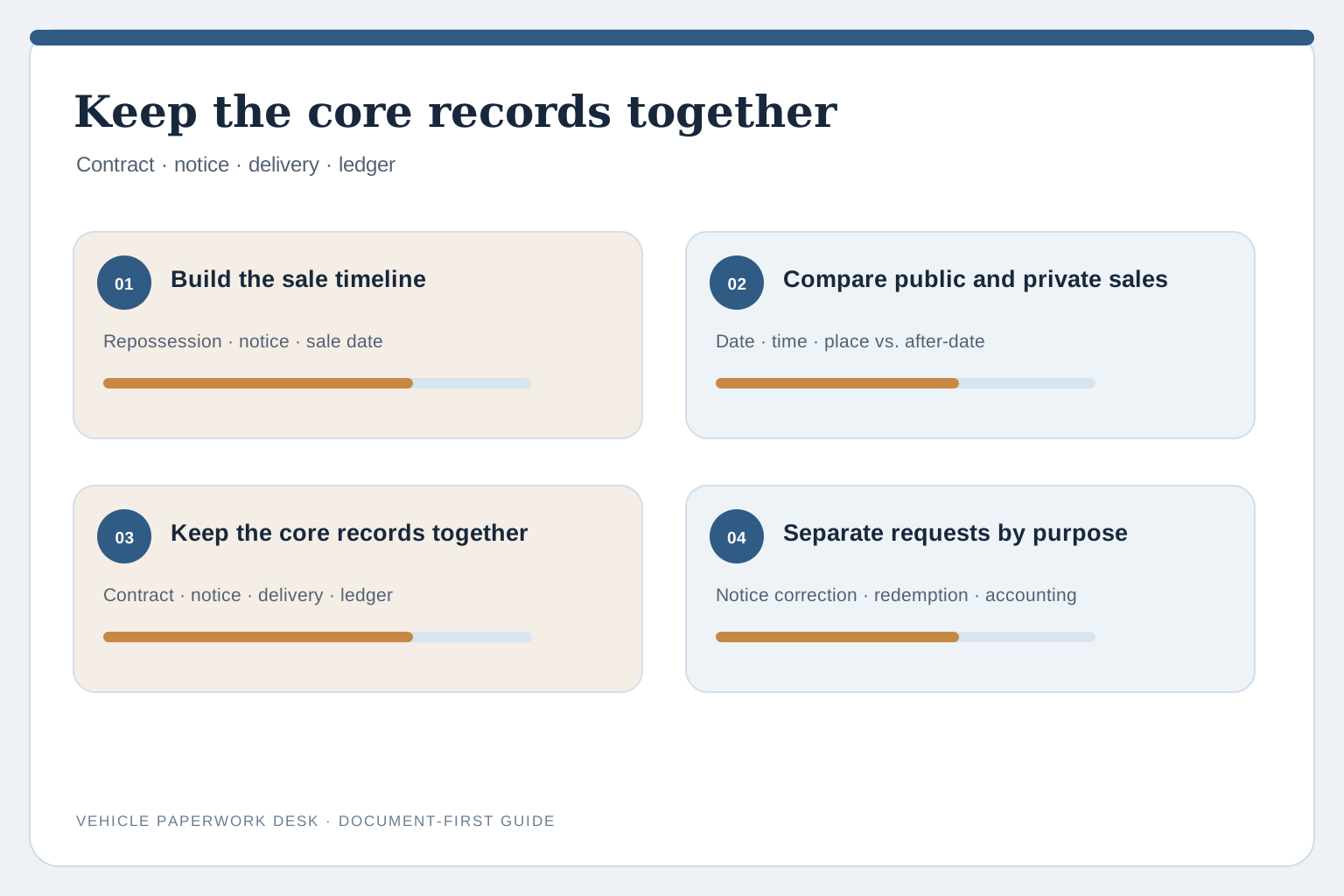
An evidence-folder checklist for reviewing a proposed repossession sale.
If the notice appears wrong or the sale is imminent
Send a written objection that names the exact issue, the document supporting it, and the action you are requesting. For example: "The VIN on the notice differs from my contract; please confirm the vehicle and any scheduled disposition date in writing." Ask whether the sale is on hold, but do not assume it is. A regulator complaint, servicer escalation, or attorney letter may be appropriate depending on the timeline; none automatically changes the sale date in every case.
Seek qualified local legal help promptly if the lender says the sale is imminent, the notice went to an address you had updated, the collateral or borrower is misidentified, you have a pending bankruptcy or military-protection issue, or you believe the repossession involved a breach of the peace. Time-sensitive rights can be lost while you wait for a routine complaint response. If you need personal items, ask the lender about its property-return process separately and document the request.
After the vehicle is sold
Ask for the disposition date, sale method, gross proceeds, itemized permitted expenses, credits applied to the loan, and the resulting balance or surplus. Keep the sale accounting with the original notice and account ledger. A deficiency calculation depends on the contract, state enactment, sale process, and expenses; a sale price alone does not prove the lender's calculation is right or wrong. For a step-by-step review of the balance, see How to Review or Challenge a Repossession Deficiency Balance.
If the lender says it kept the vehicle in satisfaction of the debt instead of selling it, ask for the written proposal or acceptance record and the legal basis. Do not assume a sale notice and a strict-foreclosure proposal are interchangeable. Different statutory steps can apply.
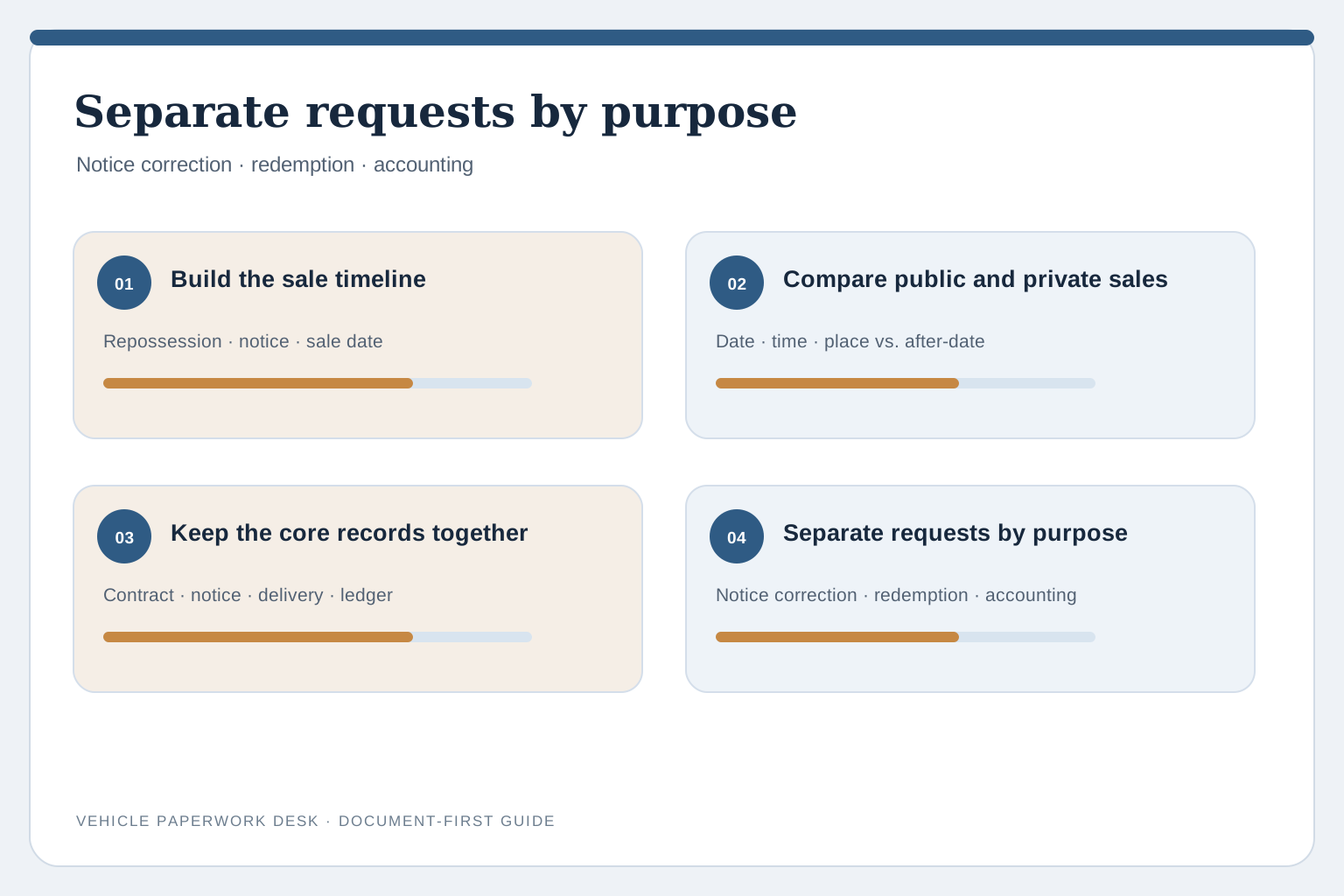
A three-lane visual separating notice objections, redemption quotes, and accountings.
Worked example: a private sale date
A borrower receives a notice stating that the lender may sell the vehicle privately after November 12. The borrower should save the envelope, compare the VIN and creditor names with the contract, ask for a current redemption quote and a separate accounting, and check the state-specific notice rules. If the lender confirms a sale hold, the borrower should request the hold terms in writing. If the lender does not confirm one, the borrower should plan as though the published date may still matter and seek local advice immediately. This example describes a record-checking method, not a guaranteed sale deadline or legal outcome.
Not legal advice. This is general information; policy, contract, and state requirements vary. Verify current rules with the agency and provider handling your case.
General information only: This is general information, not legal advice - consult a local attorney for your specific situation. State law, contracts, and agency procedures can change the answer.
Sources
- Federal Trade Commission - Vehicle Repossession
- Texas Business & Commerce Code, Chapter 9 - Secured Transactions
- Cornell Legal Information Institute - Uniform Commercial Code, Article 9
- CFPB - What happens if my car is repossessed?
Sources are provided so you can verify the controlling public guidance. State forms, fees, addresses, and procedures can change.
Frequently asked questions
Does a repossession sale notice have to give the auction date?
The answer depends on the sale method and state law. A public sale notice may need to state the time and place; a private sale notice may state when or after what date the sale can occur. Check the current state statute and the transaction documents.
Does the lender have to give me 10 days before selling my repossessed car?
Do not assume a universal 10-day period. For example, Texas Business and Commerce Code § 9.612's 10-day timing rule applies to transactions other than consumer transactions. Consumer notice timing must be checked under the controlling state law.
Is the sale notice the same as a redemption quote?
Usually they serve different purposes. Ask separately for a written, date-specific redemption amount, required payment method, and deadline. Redemption rights and amounts vary by state, contract, and case facts.
Will asking the lender to correct a notice stop the sale?
Not automatically. Request a written confirmation that the disposition is on hold and its terms. A dispute or complaint does not pause every sale under every state's law.
What should I request after the lender sells the vehicle?
Request the sale date and method, gross proceeds, itemized permitted expenses, credits to the account, and a written final accounting showing any deficiency or surplus. Compare it with your contract and state law.